
GDP
ZAMBIA GDP KEY FIGURES 2025, SIZE, GROWTH, PER CAPITA
| GDP at Market Prices 2025 | Real GDP Growth 2025 | Q1 2026 Growth | GDP Per Capita 2025 |
|---|---|---|---|
| ZMW 725,641.4 million | 3.8% | 7.7% | USD 1,317.9 |
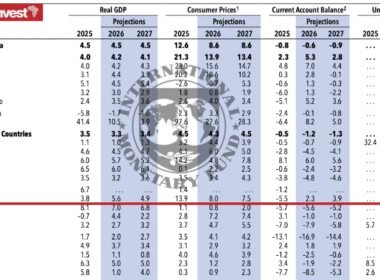
Zambia’s GDP at market prices reached ZMW 725,641.4 million in 2025, with real growth of 3.8% for the full year before accelerating sharply to 7.7% year on year in the first quarter of 2026 on a copper-led rebound.
Wholesale and retail trade, transportation and storage, and mining of metal ores are the three largest sectors of the economy, together accounting for more than 44% of GDP, while GDP per capita in current US dollars recovered to USD 1,317.9 in 2025 after dipping in 2023 and 2024 on Kwacha depreciation.
GDP Size and Growth
Zambia’s GDP at market prices, in nominal Kwacha terms, reached ZMW 725,641.4 million in 2025, up from ZMW 662,093.7 million in 2024[1]. Nominal GDP has grown roughly sevenfold since 2010, when it stood at ZMW 97,215.9 million, though that increase reflects cumulative inflation and Kwacha depreciation over the period far more than real economic expansion[1]. In real terms, GDP grew 3.8% in both 2024 and 2025[1].
Growth accelerated sharply into 2026: real GDP grew 7.7% year on year in the first quarter, up from 4.5% in the first quarter of 2025 and well ahead of the Bank of Zambia’s own 5.8% estimate for the quarter, driven by a 3.5% rise in copper output after a fourth-quarter 2025 contraction[2][3]. That followed an uneven 2025: fourth-quarter growth had slowed to just 1.6%, well short of the Bank of Zambia’s 5.4% projection, on a weak agricultural season[3]. As of April 2026, the Bank of Zambia, Ministry of Finance and National Planning, IMF and FocusEconomics projected full-year 2026 growth of between 4.3% and 5.1%, all down from earlier forecasts above 6.0%[3].
Sectoral Composition
Zambia’s economy is dominated by three sectors: wholesale and retail trade at 16.49% of 2025 GDP (ZMW 119,645.7 million), transportation and storage at 14.12% (ZMW 102,429.1 million), and mining of metal ores at 13.54% (ZMW 98,284.4 million), together accounting for more than 44% of total output[1]. Construction follows at 9.35% (ZMW 67,817.7 million), with public administration and defence at 4.71%, real estate activities at 4.04%, financial services excluding insurance at 3.69%, education at 3.47%, and food, beverage and tobacco manufacturing at 3.16% rounding out the next tier[1]. Crop and animal production, at 2.70% of GDP, is the largest single agricultural sub-component, and combines with forestry and logging at 1.06% and fishing and aquaculture at 0.35% for a total agricultural contribution of 4.11%[1]. Other mining and quarrying activities add a further 1.99%, bringing total mining’s share to 15.5% when combined with metal ore mining, the single largest sector on that combined basis[1]. Information and communication contributes 3.12%, electricity, gas and air conditioning supply 1.48%, insurance and pension funds 1.23%, and accommodation and food service activities, the closest proxy for tourism, 0.95%[1]. Detailed sector-level data, current sources and policy context for mining, agriculture, transport, construction, real estate, finance, telecoms, energy and tourism are covered on their own dedicated category pages on this site.
GDP Per Capita
GDP per capita in current US dollars stood at USD 1,317.9 in 2025, according to World Bank data, recovering from USD 1,187.1 in 2024 and USD 1,330.7 in 2023[4]. The dip through 2023 and 2024 reflects Kwacha depreciation against the US dollar over that period rather than a fall in Kwacha-denominated output, and the 2025 recovery is consistent with the Kwacha’s subsequent appreciation covered on the dedicated Economy page[4].
Investment Opportunities
The concentration of GDP in wholesale and retail trade, transportation, and mining points to where the largest pools of economic activity already sit, while sectors with a smaller current GDP share but faster growth, such as construction at 9.35% of GDP, and non-metallic mineral products manufacturing, up 18.1% in real terms in 2025, indicate where the mix is shifting[1]. The sharp swing between fourth-quarter 2025’s 1.6% growth and first-quarter 2026’s 7.7% also underscores how directly Zambia’s quarterly growth rate still tracks the copper cycle and the agricultural season, a volatility any investor sizing exposure to the broader economy needs to plan around[3].
Last Update: September 2026