
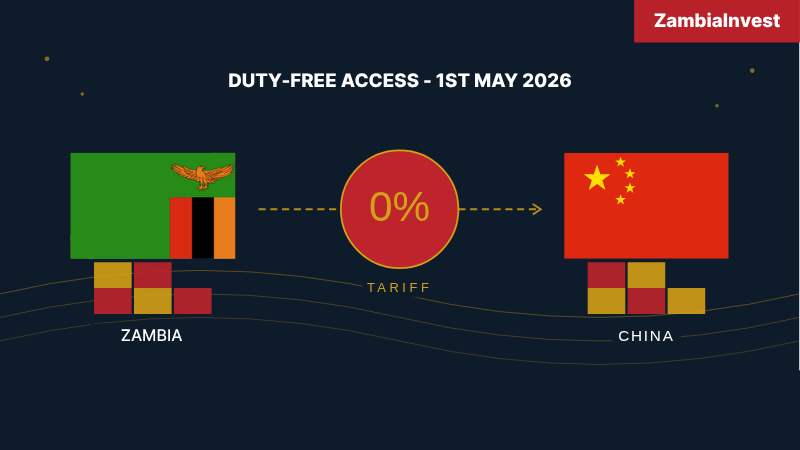
Zambian exporters have gained duty-free access to China on 100% of tariff lines from 1 May 2026, under a zero-tariff policy that now covers 53 of Africa’s 54 countries, with Eswatini the only excluded nation due to its diplomatic recognition of Taiwan.
The measure covers agricultural products, minerals, light industry, and manufactured goods, and is structured around the China-Africa Economic Partnership for Shared Development.
For products under tariff quotas, only the in-quota tariff rate is reduced to zero, while the out-of-quota rate remains unchanged.
Supporting measures introduced alongside the tariff cuts include a green channel for African agricultural products, digitalization of rules of origin procedures, and mutual recognition of inspection and quarantine standards, all aimed at reducing customs clearance costs and time.
The measure extends an earlier framework that since 1 December 2024 had granted zero-tariff access only to 33 African Least Developed Countries (LDCs), and now adds 20 non-LDC African economies including Kenya, Egypt, Nigeria, and South Africa.
For the 20 non-LDC countries, zero tariffs apply as a preferential rate for two years, from 1 May 2026 to 30 April 2028, during which China intends to negotiate the China-Africa Economic Partnership for Shared Development agreement.
The policy was announced by Chinese President Xi Jinping in February 2026 during the 39th African Union Summit and formalized by the Customs Tariff Commission of the State Council on 28 April 2026.
China is the first major global economy to unilaterally grant full tariff exemption to all African countries with diplomatic ties.
For Zambia, the policy’s direct impact on copper, the country’s main export to China, is limited because copper ore (HS 2603) and refined copper (HS 7403) already entered the Chinese market duty-free under existing most-favored-nation rates.
The opportunity for Zambia, therefore, lies in non-traditional and value-added exports, including processed copper products, gemstones, honey, soybeans, sugar, cotton, tobacco, horticultural products, and light manufactures, which previously faced Chinese tariffs of up to 25%.
The policy is structured to incentivize export diversification away from raw mineral commodities and to support the development of higher value-added industries.
African Union Commission Chairperson Mahmoud Ali Youssouf described the initiative as particularly vital given Africa’s exposure to global economic uncertainties, while United Nations Secretary-General Antonio Guterres called on other developed economies to adopt similar measures.
According to Wang Jinjie, Deputy Secretary-General of the Peking University Center for African Studies, the zero-tariff policy significantly reduces market entry barriers for African products, paving the way for higher export volumes and more diversified product categories.
According to data from the United Nations Comtrade database, Zambia’s exports to China reached USD 2.34 billion in 2024, while China’s imports from Zambia totalled USD 5.24 billion in the same year, with copper accounting for the bulk of the trade flow.
According to the Chinese Ministry of Commerce, China-Africa trade reached USD 295.6 billion in 2024, the fourth consecutive record year, and China has remained Africa’s largest trading partner for 16 consecutive years.
In the first quarter of 2025, following the initial rollout of the zero-tariff policy to 33 African LDCs in December 2024, Chinese imports from these countries rose 15.2% year-on-year to USD 21.42 billion, with coffee imports surging 70.4% and cocoa bean imports rising 56.8%.
Chinese enterprises have developed the Zambia-China Economic and Trade Cooperation Zone, which is building a complete copper industry chain from mining to smelting and processing, supporting Zambia’s strategy to raise the added value of mineral exports.
Zambia is currently implementing a national strategy to triple copper production to 3 million tonnes per year by 2031.
China has been one of Zambia’s largest sources of foreign direct investment in recent years, with significant engagement in mining, infrastructure, energy, and manufacturing.
The zero-tariff framework is aligned with China’s 15th Five-Year Plan (2026-2030), which prioritizes higher-standard opening up and the creation of a transparent and predictable institutional environment for trade and investment cooperation.