
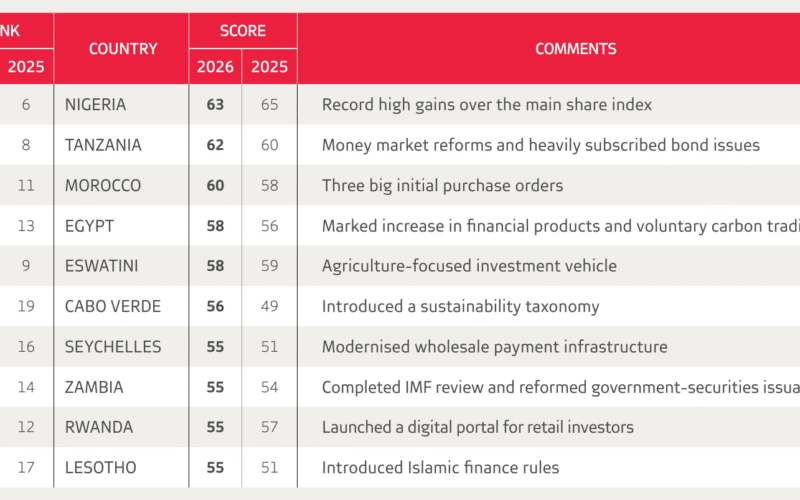
Zambia’s score in the Absa Africa Financial Markets Index 2026 rose to 55 from 54, after the country formally exited default following sovereign credit rating upgrades.
The 10th edition of the index was launched on 14 October 2026 in Bangkok, Thailand, during the International Monetary Fund (IMF) and World Bank Annual Meetings, by the Official Monetary and Financial Institutions Forum (OMFIF) and Absa Group (JSE: ABG), with support from the United Nations Economic Commission for Africa (UNECA).
Zambia ranked 15th among the 29 African economies assessed, slipping from 14th in 2025 as Cabo Verde and Seychelles moved ahead with larger gains, in a ranking led by South Africa at 85, Mauritius at 77, and Namibia at 71.
The report credited Zambia’s progress to its exit from default, sovereign rating upgrades, continued reforms under its IMF Extended Credit Facility programme, and an overhaul of government securities issuance.
The IMF completed the sixth review of Zambia’s Extended Credit Facility in January 2026, within the period covered by the index.
Zambia recorded the largest increase in market size among all 29 countries, with the dollar value of its outstanding sovereign bonds nearly doubling in a year, supported by an appreciating exchange rate.
The report attributed the gain to the normalisation of the sovereign debt market after external debt restructuring, the introduction of larger benchmark bonds, and a more consistent issuance framework, lifting Zambia’s market depth score 2 points to 37.
Liquidity remained at the minimum score of 10, and survey respondents in Zambia identified significant government debt issuance and very high government bond yields as possibly crowding out equities and corporate bonds.
The macroeconomic environment pillar posted Zambia’s largest improvement, rising 10 points to 63, with a perfect score of 100 for non-performing loans and 73 for GDP growth.
However, Zambia’s external debt rose 13.3 percentage points to 63.7% of GDP, the largest increase in the index, driven by new foreign-currency disbursements, mainly from the IMF and World Bank, and by accumulated interest arrears.
According to the IMF, Zambia is one of four index countries at high risk of debt distress, alongside Cameroon, Kenya, and Mozambique.
Market transparency rose 1 point to 84, with Zambia reaching the maximum score of 100 for macroeconomic data transparency and holding sovereign credit ratings from both S&P and Fitch.
Access to foreign exchange increased 1 point to 57, combining a perfect reporting standards score with 70 for FX arrangements and controls, 45 for reserve adequacy, and 11 for interbank FX liquidity.
Zambia’s legal standards, tax, and regulatory environment score fell 6 points to 78, although it remains one of 12 index countries where close-out netting is enforceable under domestic law.
Within this pillar, Zambia scored 100 for collateral enforceability and ESG initiatives, but only 33 for financial stability regulation and 36 for its tax environment.
Pension fund development was unchanged at 13, but the report noted that pension reforms enacted in June 2026 created sub-schemes for informal sector workers with flexible and voluntary contribution options.
The reforms also allow contributors to receive part of their pension early as a lump-sum payout, although the report noted it is too early to assess their impact on participation and savings.
Under the index’s new methodology, Zambia’s recalculated overall scores were 53 in 2022, 55 in 2023, 56 in 2024, and 54 in 2025, against 55 this year.
Absa Africa Financial Markets Index
The index was launched in 2017 by OMFIF and Absa, and the 2026 edition covers 29 economies representing approximately 80% of Africa’s population and gross domestic product.
Countries are scored from 10 to 100 across six pillars: market depth, access to foreign exchange, market transparency, pension fund development, macroeconomic environment, and legal standards, tax, and regulatory environment.
The 2026 edition draws on public data and a survey of more than 40 organisations conducted between June and August 2026, including the Bank of Zambia and the Bankers Association of Zambia.
This year the index moved to fixed reference bounds for scoring, so that changes reflect each country’s own performance rather than shifts elsewhere in the sample, and recalculated all scores back to 2022.
Across the index, the average score reached 56, the highest in 10 years and 6 points above the 2017 launch, with 21 of the 29 countries improving their scores.
Absa Group holds a majority stake in Absa Bank Zambia and also runs insurance operations in the country.